 RICHARD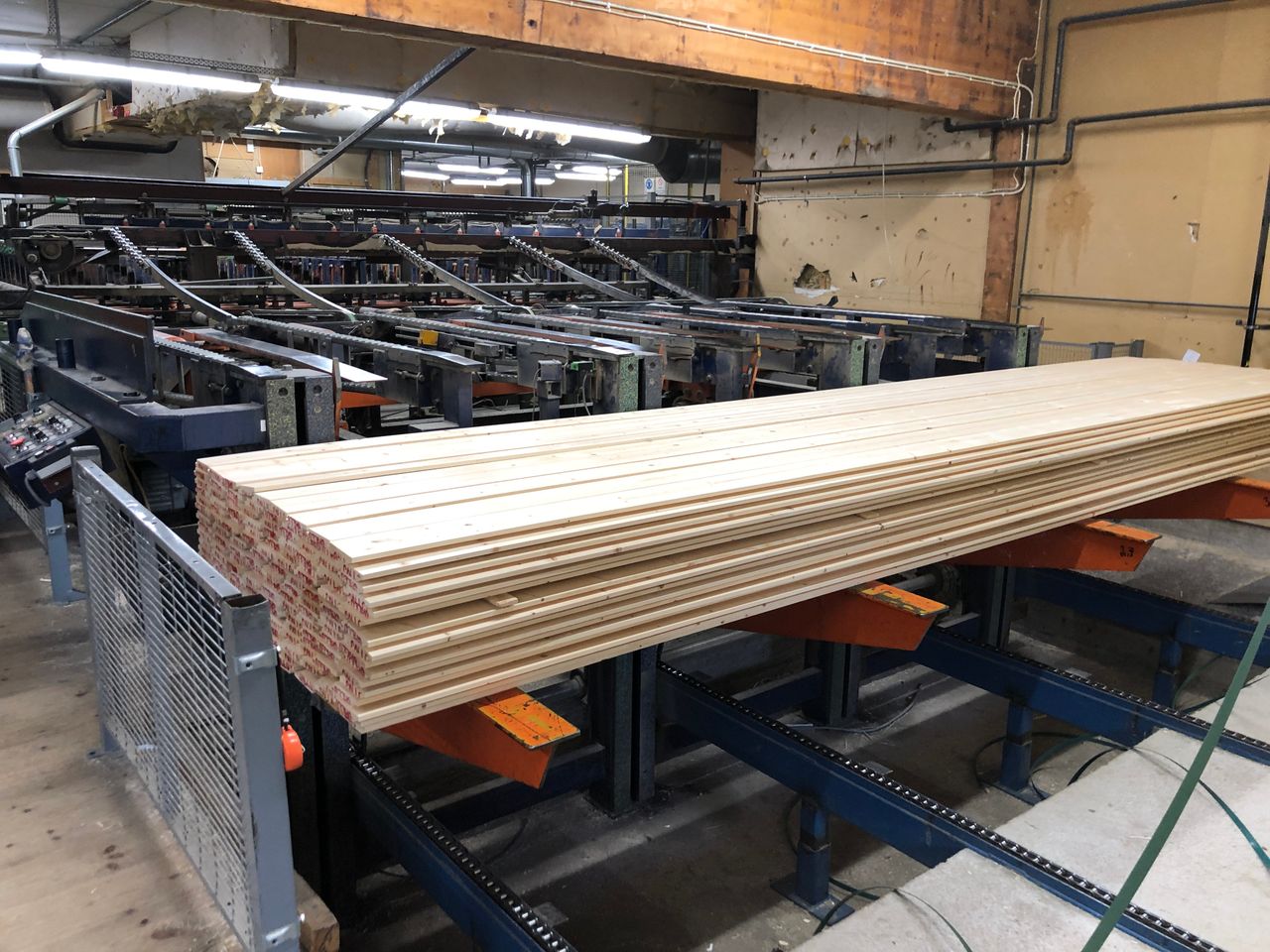
The Bottleneck Rarely Sits at the Saw
Ask most sawmill owners what limits capacity and they'll talk about blade type, motor power, or cutting speed. Walk the floor on an ordinary shift and you'll usually see something else: a stack of timber waiting to be fed in, a section where the line stands still because someone is moving packages by hand, an outfeed where two workers are stacking manually while the saw has already produced the next board. The saw itself is rarely the bottleneck — it waits almost as much as it cuts. It's the handling around it — infeed, transport between stations, and outfeed, in other words the timber handling equipment — that decides how many cubic metres actually leave the building each shift. The right equipment often costs less than expected, especially bought used, and frequently delivers a bigger production gain than the next saw upgrade. Here's what actually controls the flow, station by station.
The Infeed: Timber Feed Tables & Timber Elevators
Everything starts with steady infeed. A sawmill that depends on a forklift driver bringing fresh timber every five minutes has already built waiting time into the process — and that driver rarely has just one job. A timber feed table solves this by holding a buffer of logs or planks right at the line and releasing them at its own pace, independent of other internal logistics. Paired with a timber elevator that lifts material to the right working height, you get a steady, controlled stream into the first station, with nobody standing there pushing timber by hand.
This is usually the investment that pays off first, because it affects everything downstream. Uneven infeed ripples through the whole line — the saw gets short stops, the next station waits, and eventually the outfeed suffers even though it works perfectly well on its own. We currently carry a timber feed table from ALMAB and a timber elevator from ALMAB in used stock — both built for continuous duty in exactly this role.
Between Stations: Chain Conveyors, Roller Conveyors & Belt Conveyors
The stretch between the saw, edger, trimmer and moulder is where most sawmills lose time without noticing. Without a real buffer between stations, the whole line only moves as fast as its slowest point — and that point keeps shifting depending on dimension, quality, and who's working where. Chain conveyors handle the heavy, continuous transport between main stations and take bark, chips, and moisture without trouble. Roller conveyors give controlled accumulation, letting timber sit for a moment without stopping the flow behind it. Belt conveyors suit lighter material best, along with chip and offcut handling, where you want to move large volumes of waste away from the work area continuously instead of someone shovelling it out every half hour.
The point of this whole transport chain is simple: the saw should never stand idle waiting for somewhere to put finished timber, and it should never stand idle waiting for the next log to arrive. A properly sized chain conveyor between critical stations solves both problems at once, and is often the single most underrated investment in an older sawmill.
The Outfeed: Package Stackers & Bundling Machines
If the infeed is where flow begins, the outfeed is where time gets stolen. Manual stacking of sawn timber is physically hard, slow, and difficult to keep consistent across a full shift — fatigue toward the end of the day shows up immediately in how neat the packages come out. A package stacker automates that step: timber is laid into even, square packages ready for stickering, strapping, or further handling, at a pace that doesn't drop off after lunch. For shorter timber — offcuts or thinner material worth recovering — there are package stacker variants built specifically for shorter lengths, where a standard model would otherwise leave too much slack between the grippers.
This is also the station where you'll see the fastest return on investment, since manual stacking often ties up two or three workers for a whole shift. Move those hands to other work in the mill and the numbers often justify themselves. A package stacker from ALMAB in our used stock is a concrete example of how much capacity is available here without buying new equipment.
Sizing Your Timber Handling Equipment Correctly
The most common beginner mistake is buying handling equipment matched to today's saw capacity instead of what you actually plan to run in a couple of years. An undersized conveyor or elevator becomes the new bottleneck soon enough, and replacing it again costs more than sizing correctly the first time. Look at maximum throughput in cubic metres per hour across the whole line, not just at the saw, and make sure every station — infeed, mid-line, outfeed — can handle at least the same volume as the next step in the chain.
Used equipment is often the fastest route to more capacity, for the simple reason that you get industrially built machinery for a fraction of new price, with short lead times. In the Swedish used market, brands like ALMAB and HALL are a proven standard — solid construction, plenty of spare parts in circulation, and a known track record in Swedish sawmills and planing mills, which makes it easier to judge condition and expected lifespan before buying. See our full range of timber handling equipment for sawmills for current stock.
FAQ
What should I invest in first — a feed table, a conveyor, or a package stacker?
It depends on where your actual bottleneck sits today. Map out where timber piles up or waits longest, and start there. For many smaller sawmills, the outfeed (manual stacking) gives the fastest return, but uneven infeed can undermine the benefit of everything else.
Can used timber handling equipment from different brands be combined in one line?
Yes, in most cases. Conveyors, elevators, and package stackers are rarely locked to a single system — what matters is physical dimensions, speed, and the interface between stations. We're happy to help assess whether a specific machine fits your existing line before you buy.
How much can the right timber handling equipment actually increase output in an older sawmill?
It varies by starting point, but several industry forums and machinery dealers point to eliminated handling stops — not saw capacity — as often the single biggest untapped production reserve in older facilities, since the saw itself can usually already handle more volume than it's being fed.