 RICHARD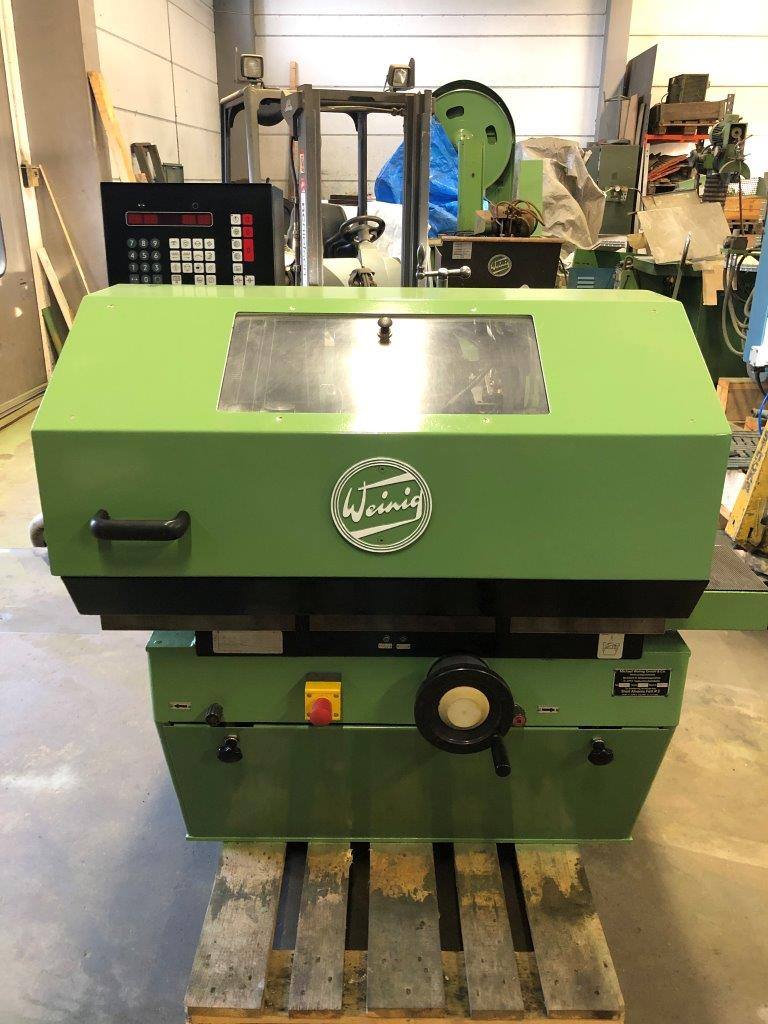
The grinding machine – the heart of a sharp sawmill
A grinding machine rarely shows up in production statistics, but it affects almost everything else in the workshop. A poorly ground saw blade or an incorrectly sharpened cutter leads to worse surface finish, higher timber consumption, and unnecessary wear on other machines. Most people who've spent years on the shop floor know that time invested in proper grinding technique pays back many times over in production. Here we've gathered concrete tips from people who work at the grinding machine daily – whether it's a simple universal grinder or an advanced CNC-controlled machine.
Keep track of the grinding angle – every time
The most common issue we see on used grinding machines coming in for refurbishment is that angle settings have been neglected over the years. Many machines, such as the Weinig R 912, have very precise adjustment options for both clearance angle and rake angle – but they only deliver correct results if the operator actually measures and documents the angle at each changeover, rather than just trusting the scale.
A simple trick: mark the standard settings for your most common tool and blade types directly on the machine or in a running log. That way the next operator won't have to guess, and you'll get more consistent quality across shifts.
Cooling isn't just for comfort
Overheating during grinding is one of the most common reasons steel and blades lose hardness at the cutting edge – often without it being immediately visible. Regularly check that the coolant flow actually hits the contact point between the grinding wheel and the tool, not just sprays nearby. On older machines that have had nozzles or pumps replaced, the flow can easily end up misaligned over time.
A good routine test: run a couple of empty grinding passes and feel the tool right after. If it's noticeably hot to hold, cooling is likely insufficient for the current feed rate.
Balance the grinding wheel before it throws you off balance
Imbalance in the grinding wheel causes vibrations that show up as uneven grinding surfaces, increased wheel wear, and in the worst case damage to spindle bearings. On universal machines like the Holytek or Jajod M 360, it's worth checking the balance every time a new wheel is mounted – not just when vibration problems become obvious. Many operators skip this step when in a hurry, but the extra five minutes saves considerably more time through fewer re-grinds and wheel changes.
Dress the wheel regularly, not just when needed
A grinding wheel that has glazed – become smooth and lost its cutting ability – produces more heat and worse results despite looking intact. Build dressing into your routine as a fixed step, ideally tied to the number of tools ground rather than "when it feels sluggish". This is especially important on machines run across multiple shifts, where different operators may otherwise have different instincts for when dressing is needed.
Match machine and steel – not just tool to tool
A common misconception is that all planer cutters and round cutters can be ground with the same settings as long as the steel quality is similar. In practice, geometry often differs between brands and model years. If you grind your own planer cutters, round cutters and steel in-house, it's worth building a simple database – ideally with photos and measurements – so the correct setting can always be found quickly, even when the regular grinding operator is away.
Combination machines require extra planning
Machines like the RK Kombi 11 can handle several tool types in one unit, which is smart for smaller workshops but requires more structured changeovers. Write a simple checklist for each tool type – angle, feed speed, cooling, dressing interval – and post it by the machine. This reduces the risk that a quick changeover skips a critical step.
Keep the spindle free of play
An often-overlooked maintenance point is the spindle bearings. Even a small increase in play degrades grinding results before it shows up as noise or vibration. On older but well-maintained machines, such as a refurbished Stehle/Schneeberger, regular checking of spindle play is one of the best investments you can make to extend the machine's lifespan and keep precision at its best.
Document deviations – not just solutions
When something goes wrong during grinding, it's tempting to just fix it and move on. But if you start noting what went wrong – too much heat, imbalance, wrong angle – you quickly build a knowledge base that helps solve similar problems faster next time, regardless of who's at the machine.
Summary
The grinding machine is an investment that pays off throughout the entire production chain. With clear routines for angle setting, cooling, balancing and dressing – plus simple documentation of settings and deviations – you get more consistent quality, longer life for both machine and tools, and fewer surprises on the shop floor.
FAQ
How often should a grinding wheel be dressed? It depends on material and load, but a good starting point is to tie dressing to the number of tools ground rather than feel. Many workshops dress at a fixed interval, for example every 20–30 grinds, and adjust from experience.
What's the most common cause of poor grinding results despite a correctly set angle? Insufficient or misdirected cooling is one of the most common causes. Even with the correct angle, overheating at the cutting edge can reduce durability and cutting ability without it being immediately visible.
Is it worth buying a used grinding machine instead of a new one? Yes, in many cases. A well-maintained used machine with documented maintenance, such as checked spindle play and balancing, can deliver the same precision as a new machine at a significantly lower investment.