 RICHARD
Common Bandsaw Faults and How to Troubleshoot Them
A bandsaw is the heart of many sawmills and joinery shops, and when it acts up, the whole production line stalls. Whether you're running a simple single bandsaw or a twin bandsaw for higher throughput, the troubleshooting approach is largely the same – you need to systematically work through the blade, tracking, tension and mechanics before concluding that the machine needs replacing.
In this article we go through the most common bandsaw faults, how to recognize the symptoms, and how to troubleshoot the problem step by step. We'll also look at when it makes sense to consider a used replacement rather than continuing to repair a worn-out machine.
1. The blade wanders or jumps off
The most common complaint from operators is that the saw blade doesn't stay put, but wanders sideways or even jumps off the wheels entirely.
Possible causes:
- Incorrect blade tension – too loose or too tight causes poor tracking.
- Worn or misaligned guide bearings.
- A warped or unevenly worn drive wheel.
- Wrong blade type or width for the machine.
How to troubleshoot:
- Check tension against the manufacturer's recommendation – many machines have a tension gauge or scale.
- Rotate the wheels by hand (with power off!) and see if the blade centers itself naturally on the wheel rim.
- Inspect the guide bearings for play or binding – replace them if they don't spin smoothly.
- Compare the blade's width and tooth pitch against the machine's specification.
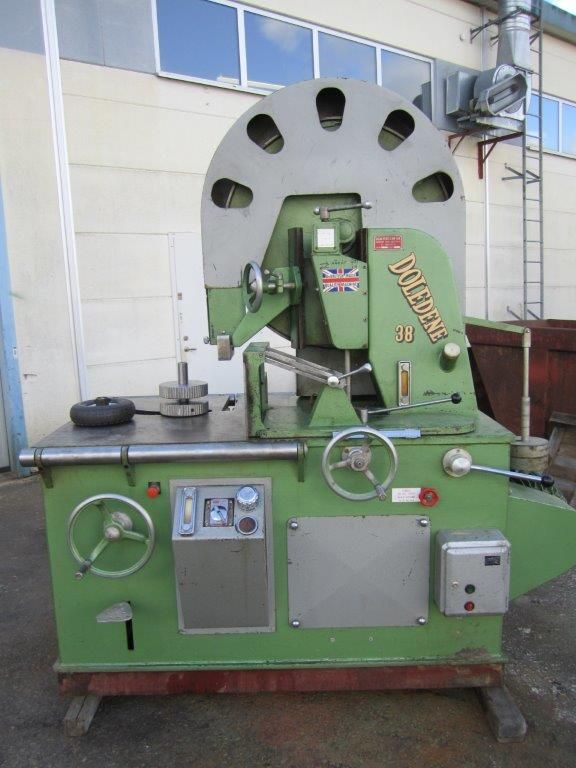
On older machines such as a classic bandsaw of the Doledene DS 38 type, it's often the guide bearings that wear out first after many operating hours, while more robust twin bandsaws like the AKE 1400 more often suffer from tension issues due to the higher load on both blades simultaneously.
2. Uneven or wavy cut surfaces
If the lumber comes out with wavy or crooked cut surfaces, it's rarely the blade itself that's at fault, but rather how the machine is set up and maintained.
Possible causes:
- A blunt or poorly sharpened blade.
- Feed rate mismatched to blade speed.
- Vibrations from worn bearings in the drive shaft or wheels.
- An uneven or flexing saw table/carriage.
How to troubleshoot:
- Replace or sharpen the blade and test again – an easy way to rule out the blade as the cause.
- Temporarily lower the feed rate and see if the surface becomes smoother.
- Listen and feel for vibrations at idle – unusual noise often indicates bearing failure.
- Check that the saw table or carriage has no play in the guides.
If the machine has already logged many hours, such as an older model like the Stenner 105, it may be more economical to replace bearings and guides in one combined maintenance session rather than chasing symptoms one at a time.
3. The motor overheats or stalls
A bandsaw that runs hot, loses power, or trips the overcurrent protection usually points to electrical or mechanical load problems.
Possible causes:
- Feed rate too high relative to the wood's hardness.
- Worn drive belts that slip and create extra friction.
- Dirt and sawdust accumulated in the motor housing or cooling fins.
- A faulty or aged electrical component (capacitor, contactor).
How to troubleshoot:
- Check the motor's temperature by hand (carefully, with the machine off and cooled down) or with an IR thermometer.
- Inspect drive belts for slack, cracks, or slip marks.
- Regularly clean the motor housing and cooling fins of sawdust and dust.
- If the fault recurs despite cleaning and belt adjustment, have an electrician measure current and voltage.
4. Shaking and unusual noise
Vibrations are often an early warning sign that something is about to break, rather than an acute fault.
Possible causes:
- Unbalanced wheels or drive belts.
- Loose bolts in the frame or motor mount.
- Worn bearings in the wheel shafts.
- An unevenly worn blade creating pulsating load.
How to troubleshoot:
- Go through all bolted joints on the frame, motor, and wheel mounts – tighten as needed.
- Check the wheels for runout by spinning them by hand and seeing if they rotate eccentrically.
- Replace the blade if it's unevenly worn, even if it's technically still cutting.
- If vibrations persist after these measures, suspect bearing failure in the shafts – these should be replaced by a technician.
When is it time to replace the machine?
Troubleshooting solves a lot, but after a certain number of operating hours, repairs become more expensive than the benefit they provide. If you notice the same fault recurring despite repeated bearing replacements, belt adjustments, and cleaning, it may be time to consider a used replacement instead of yet another repair. Switching to a more modern or robust machine, for example a twin bandsaw for higher capacity, can often pay for itself quickly in reduced downtime.
Summary
Most bandsaw faults can be traced to four main areas: blade tension and tracking, cut quality, motor/drivetrain, and vibrations. By systematically working through these points before calling for service, you can often solve the problem yourself – or at least narrow down where the fault lies, which saves time and money once the technician arrives.
FAQ
How often should I check the blade tension on my bandsaw? Check the tension daily at the start of the shift, and always after a blade change. Temperature swings in the workshop can also affect tension, so an extra check during large temperature shifts is wise.
Can I troubleshoot vibrations myself or do I always need a technician? You can check bolted joints, belts, and blade condition yourself, which resolves a large share of vibration issues. If the vibrations persist after this, especially if they come from the wheel shafts, a technician should perform a bearing inspection.
Is it worth repairing an older bandsaw or should I replace it? It depends on how often faults recur and what the repairs cost over time. If the same types of faults show up several times a year despite maintenance, it's often more cost-effective to invest in a used, newer machine rather than continuing to repair.