 RICHARD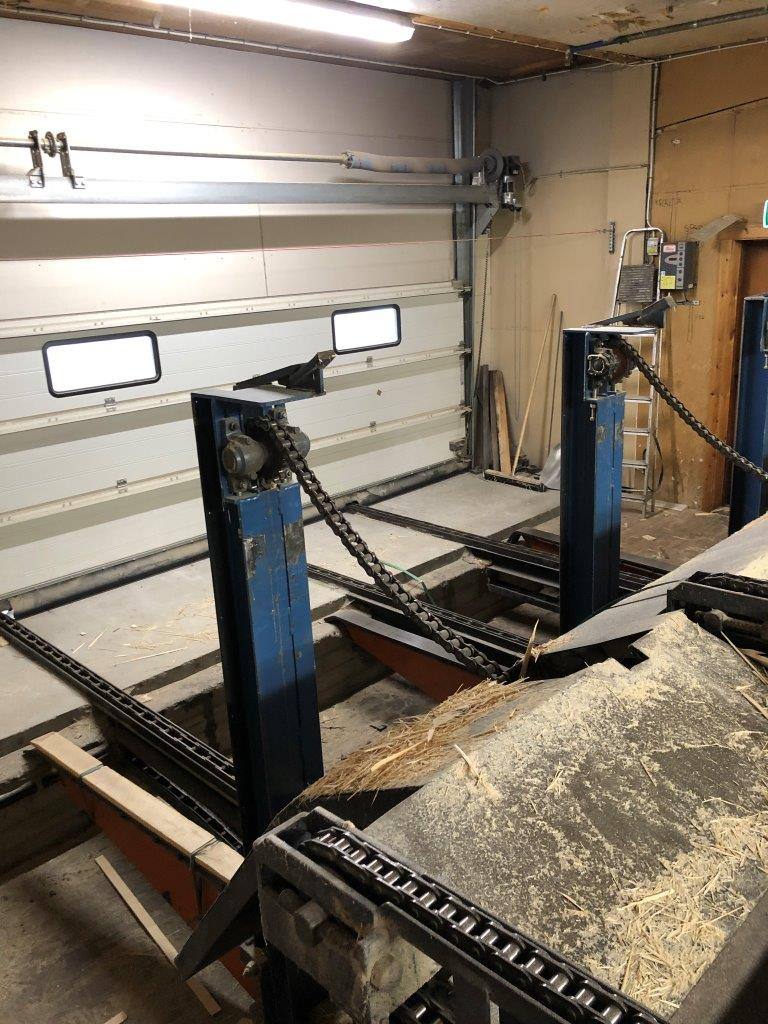
Buying guide: what to check before purchasing a used complete sawmill line
Investing in a complete sawmill line is one of the biggest decisions a sawmill business makes. Unlike a single machine, it involves an entire system of interacting parts – infeed, positioning, sawing, sorting and transport – where every link has to work together with the others. Buying used can save significant money compared to a new investment, but the risks are also greater if you don't know what to look for. This guide walks through what you should concretely check before signing for a used sawmill line.
1. Map out capacity and bottlenecks
Before you even visit a facility, calculate the capacity you actually need – cubic meters per shift, log diameters, lengths and volumes. A complete line such as the Valbo line 1 is dimensioned for a certain capacity level, and it's important that it matches your production rather than the seller's previous operation. An oversized line costs unnecessarily in operation and maintenance, while an undersized line becomes a bottleneck from day one.
Ask the seller for production data: how many hours per day has the line run, what volume has been produced per year, and what species and dimensions has it handled? This tells you more about actual load than age alone.
2. Inspect every subsystem separately
A sawmill line is only as strong as its weakest link. Go through each station individually:
- Infeed and positioning – check that positioning cradles and infeed stations, such as a positioning cradle, move smoothly without sticking and that hydraulics don't leak. Worn guide rails or slack in the cradle result in poorer positioning accuracy and thus lower yield.
- Elevators and conveyors – a log elevator is subjected to constant load and wear. Look at chains, bearings, drives and guards. Rusty or stretched chains are an expensive item to replace afterwards.
- Infeed to planer or splitter – if the line includes a planer or splitter infeed, check that feed rollers still have rubber or spikes intact, and that synchronization with the next station works without collisions or stoppages.
- Saw units – check saw blades/bands, bearing play in saw shafts and that dimension adjustment mechanisms work correctly.
- Sorting and outfeed – ensure the sorting system handles the speeds the line is built for, and that photocells/sensors work.
3. Control system, wiring and PLC
This is often the most underestimated part of buying used lines. Ask what control system is used, whether PLC programs and parameters are included in the purchase, and whether there's documentation or support from the original manufacturer. A system without accessible source code or spare parts for the control cabinet can become a major headache the day something breaks. Also inspect wiring, cabinets and contactors for signs of overheating or corrosion – common in humid sawmill environments.
4. Maintenance history and documentation
Ask for maintenance logs, service agreements and any incident reports. A line operated by a serious business with planned maintenance is far safer than a line that's been running without documentation. If possible, talk to the technician or department that handled daily operations – they usually know best where the recurring problems are.
5. Disassembly, transport and reassembly
A complete line is rarely simple to move. Find out:
- Who is responsible for disassembly – the seller or you?
- Are there drawings and labeling of cabling and piping for reassembly?
- What foundations and floor conditions are required at your facility?
- Will you need external help for installation, calibration and commissioning?
Don't underestimate this cost. In some cases it can be as large as the machine investment itself, especially if the line requires new power supply, compressed air, or foundation work.
6. Spare parts and manufacturer support
Check whether the manufacturer still exists, whether there's a secondary market for spare parts, and whether local technicians are familiar with the system. A line from a well-established supplier is often easier to keep running long-term than a unique, custom solution with no remaining support.
7. Test run in real operation
If possible, insist on seeing the line run with real timber in its current environment before purchase. A stationary line may look fresh but hide problems only visible under load – vibrations, uneven feeding, noise from bearings or gears. A short test run often reveals more than an hour of visual inspection.
Summary
Buying a used complete sawmill line is about seeing the whole picture, not just individual machines. Capacity, component condition, control systems, documentation and logistics for moving and installation are all decisive factors. Take your time, request documentation, and test-run if possible before deciding – it's the best insurance against costly surprises after purchase.
FAQ
Is it worth buying a complete used sawmill line instead of individual machines? Often yes – the total cost tends to be lower and the components are already matched to work together. But it requires careful inspection of every subsystem to avoid hidden compatibility issues.
How important is the control system when buying a used line? Very important. A control system without accessible documentation or spare parts can make the entire line difficult to commission and maintain long-term.
What extra costs should I budget for beyond the purchase price? Budget for disassembly, transport, foundation work, electrical installation, and possible calibration during reassembly – this can become a significant part of the total cost.