 RICHARD
How to compare band saw models and production years
Choosing the right used band saw is rarely about finding the "best" machine in an absolute sense. It's about finding the model and production year that fits your production flow, timber volume, and budget. Because band saws come in so many configurations — from simple workshop saws to powerful twin-blade log saws — a structured comparison is essential to avoid costly mistakes.
In this article we go through the parameters that actually matter when comparing different band saw models and production years on the used equipment market.
Start with the intended use
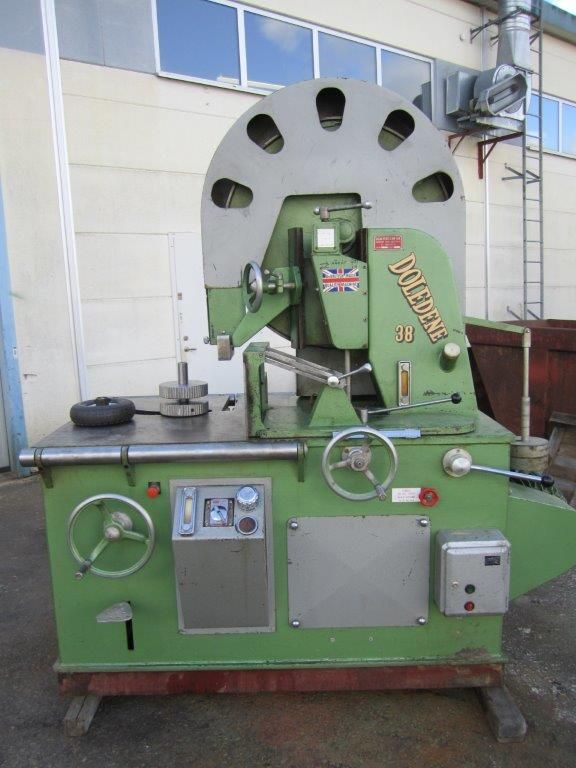
Before even looking at production years, define what job the band saw needs to do. A classic workshop band saw, such as the Band saw (Doledene DS 38), works excellently for cutting and simpler breakdown in small to medium facilities. If instead you handle large volumes of logs with demands for high capacity and precise dimensioning, a twin band saw, like the Twin band saw (AKE 1400), is often a better choice since it cuts from two directions simultaneously, cutting throughput time in half.
It's easy to get stuck comparing price and condition before confirming the machine is even the right type for the job. Always do this step first.
Capacity: dimensions and throughput
Once the intended use is clear, capacity is the most important technical parameter to compare. Look at:
- Maximum log diameter / opening size – determines which dimensions you can cut without restriction.
- Blade length and width – affects cutting precision, kerf width and waste percentage.
- Feed speed – determines how many cubic meters you can produce per shift.
- Motor power – especially important when cutting hard or wet wood species.
A Band saw (Canali TB 1100) and a Band saw (Robinson EFT 36) might look equivalent on paper but differ significantly in practical capacity depending on feed system and blade tension. Always ask the seller for concrete production figures, not just technical specs from a brochure.
Production year says less than you'd think – but not nothing
Many buyers fixate on manufacturing year as the sole measure of quality. In reality, production year is a fairly blunt indicator because:
- A machine from 1998 that has been thoroughly overhauled can be in better condition than a 2010 machine that's been run hard without maintenance.
- Some models have a design that has barely changed over decades, meaning an "older" model can still be fully competitive.
- Electronics and control systems often age faster than the mechanical construction, which is why these parts deserve extra scrutiny on older machines.
What matters more is: how many operating hours has the machine run, what maintenance is documented, and which wear parts (wheels, bearings, guides) have been replaced. Always ask for service history when comparing two production years of the same model.
Technology developments to watch for
Even though the basic design of many band saws has stayed relatively constant, there are technical differences between generations that affect both productivity and working environment:
- Blade tensioning systems – newer models often have hydraulic or pneumatic tensioning instead of manual, giving more even cuts.
- Guides and wheel bearings – updated bearing solutions reduce vibration and extend blade life.
- Digital controls – some newer production years have measuring computers for automatic positioning, increasing yield during breakdown.
- Safety equipment – emergency stops, guards and sound insulation have improved step by step and can be decisive for workplace safety requirements.
When comparing two production years of the same brand, it's worth asking specifically about these points rather than just looking at the manufacturing year as a whole.
Condition and refurbishment level matter more than age
A well-maintained band saw can provide many more years of operation regardless of its original manufacturing year. Therefore check:
- Wear on wheels and rubber coating.
- Play in guides and bearing housings.
- Straightness and tension in the frame structure – a twisted frame never gives straight cuts, no matter how new the machine is.
- Whether the electrical system and motors are original or replaced, and if so, when.
Ask for photos or a test run before purchase, and always compare condition between the units you're considering — not just the specifications on paper.
Pricing based on the comparison
Once you've gathered information about capacity, production year, technology and condition, you can make a reasonable price comparison. As a rule of thumb:
- Newer production years with documented low operating hours justify a higher price.
- Older machines with major refurbishment and new wear parts can be price-competitive despite their age.
- Machines without service history should be priced lower since hidden refurbishment costs often follow.
By systematically comparing several listings using the same criteria, you'll quickly get a feel for what constitutes a fair market price for the specific model and capacity you're looking for.
Checklist before comparing
- Define intended use and volume requirements.
- Compare capacity (diameter, blade length, feed speed).
- Ask about service history and operating hours, not just production year.
- Check the technology generation (tensioning system, controls, safety).
- Assess physical condition through photos, visits or test runs.
- Compare price relative to all the above factors — not in isolation.
FAQ
Is a newer band saw always better than an older one? Not necessarily. An older machine with documented maintenance and replaced wear parts can perform just as well as a newer but poorly maintained one. Focus on condition and service history rather than year alone.
Which measurements should I compare between different band saw models? The most important are maximum log diameter, blade length and width, feed speed, and motor power. These determine both capacity and what type of timber the machine can handle efficiently.
How do I know if a twin band saw is the right choice compared to a single band saw? If you handle large log volumes and need high throughput, a twin band saw is often more profitable since it cuts in two directions simultaneously. For smaller volumes or simpler cutting, a standard band saw is usually sufficient.