 RICHARD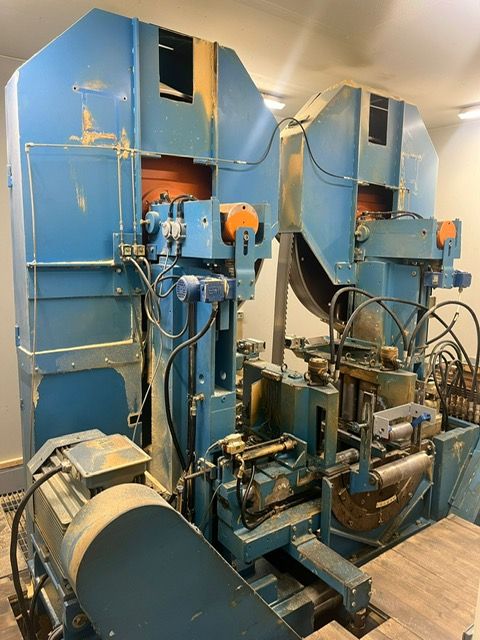
Band Saw Safety and Work Environment at Sawmills
The band saw is one of the most heavily used and potentially hazardous operations in a sawmill. High speeds, large blades and a continuous flow of timber mean that pinch points, cutting injuries and noise exposure are part of everyday work unless routines are solid. For anyone responsible for production, the work environment around the band saw isn't just a compliance issue – it's a direct investment in uptime and staff health.
Common risks around band saws
Whether it's a simple band saw, a twin band saw or a log band saw with a carriage, the same types of risk keep recurring:
- Pinch injuries during infeed and when repositioning timber on the carriage.
- Blade failure, where a damaged or incorrectly tensioned blade can be thrown with significant force.
- Cutting injuries from manual handling of blades, especially during changeovers or cleaning.
- Noise that causes hearing damage with prolonged exposure.
- Dust and chips, which pose both fire risk and respiratory concerns.
A machine such as /en/maskiner/RP-05013 (twin band saw) carries extra risk points since two blades operate simultaneously – requiring clearer guarding zones and better operator visibility.
Regulations and risk assessment
Under Swedish work equipment regulations (AFS 2006:4), every machine must be risk-assessed before use, and the assessment must be updated whenever usage or layout changes. This is particularly important for used band saws moved into a new production line – old guards may have been designed for a different setup or floor plan.
In practice, this means you should:
- Document where pinch and cutting risks exist in your specific setup.
- Verify that emergency stops are within reach from every work station.
- Confirm that guards and blade covers remain correctly fitted after transport or refurbishment.
- Review lighting and sightlines around infeed and outfeed.
Guarding, emergency stops and ergonomics
Physical guards are the first line of defence. The blade should be covered as far as possible outside the actual cutting zone, and emergency stops should be located both at the operator position and at any unloading side. On older machines it's not uncommon for guards to have been removed for maintenance and never correctly refitted – a simple but serious deviation to look for during a safety review.
Ergonomics matters too. Manual handling of heavy logs or bundles, repeated bending during infeed, and static working postures at the carriage controls all contribute to strain injuries over time. For log band saws with a carriage, such as /en/maskiner/RP-05016, it's worth reviewing carriage controls and whether the operator can work standing in a neutral position throughout the cycle.
Dust, chips and fire risk
Band sawing generates large volumes of chips and dust, which is both a work environment issue and a fire risk. A properly sized extraction system reduces exposure to fine particles and keeps floors clear of slip hazards. If chip buildup accumulates quickly around the machine, or air quality in the hall feels poor, it's often a sign that extraction capacity doesn't match production. /en/maskiner/RP-48002 is an example of the kind of peripheral equipment – chip extraction fans – that is often overlooked when attention is on the saw itself, but which is critical for a safe work environment.
Blade and tool maintenance
A blade in poor condition is one of the most common causes of incidents. Tensioning faults, cracking and worn teeth increase the risk of blade failure and kickback. Routine inspection of blade condition, correct tensioning and regular sharpening significantly reduce risk. If you use cutterheads or knives in ancillary equipment around the saw, for example during edging, it's worth reviewing the quality of items such as /en/maskiner/RP-65003 – worn tooling increases both injury risk and machine strain.
Training and routines
No guard replaces a trained operator. Baseline requirements should include:
- A walkthrough of emergency stops and shutdown procedure before the first shift.
- A defined blade-change routine – who performs it, with what protective equipment, and how the machine is locked out during the change.
- Regular refresher training, particularly after incidents or new hires.
- Clear signage for personal protective equipment: hearing protection, respiratory protection where dust exposure occurs, and eye protection.
A simple checklist posted near the machine – daily start-up check, weekly blade inspection, monthly guard review – ensures responsibility doesn't rest solely on the individual operator but becomes part of ongoing operations.
Summary
Safety around the band saw is rarely about one big fix, but about combining functioning physical guards, well-maintained tooling, properly sized extraction and trained staff. Work through these points systematically and you'll reduce both accident risk and downtime – two things that are more closely linked than many realize.
FAQ
Do all band saws need emergency stops in multiple locations? Yes, if the machine has multiple work stations – such as infeed and outfeed – emergency stops must be within reach from each station under AFS 2006:4.
How often should the blade be checked for cracks? A visual check should be done daily before operation, with a more thorough inspection at every blade change or sharpening.
Is local extraction at the saw enough, or is central extraction needed? It depends on production volume and hall ventilation, but under continuous operation a properly sized central system, such as chip extraction fans, is often necessary to control dust and fire risk.